
After 60, a bad investment isn't just a setback — it's a threat to the life you've built. The problem? Many of the riskiest options are marketed directly to retirees. In this series, you'll learn which investments to avoid, the warning signs most people miss, and the specific questions that can protect your savings starting today.
Your Nest Egg Plays by Different Rules Now
You already know this in your gut: a financial mistake at 62 hits differently than one at 42. It's not about being less sharp or less capable — it's simple math. At 40, you had two decades of earning power to bounce back from a bad investment. At 60, that runway has shortened dramatically. The strategies that built your wealth were designed for a longer time horizon. They worked beautifully then. But the clock has changed, and your playbook needs to change with it.

Financial professionals call it "recovery time" — the years needed to climb back from a major loss. It's the single most important concept for investors over 60, and we'll put real numbers to it soon. But first, there's a common belief about market returns that misleads nearly everyone.
Why "Average Returns" Can Lie to You
You've probably heard that the stock market returns 8-10% per year on average. That's technically true over long stretches. But here's what that number hides: the order your returns arrive in matters enormously when you're pulling money out. Imagine you retire and start withdrawing $40,000 a year. If the market drops 30% in your first year, you're now selling shares at rock-bottom prices just to pay your bills. Those shares are gone forever — they'll never recover for you.

This is called sequence of returns risk, and it's the reason two people with identical average returns can end up with wildly different outcomes. One retires into a bull market and thrives. The other retires into a downturn and runs out of money years early. So what's the simplest way to protect yourself? It starts with one question.
The One Question That Changes Everything
Here's a tool you can use starting right now — before evaluating any investment, ask one question: "How long until I can access this money without penalty or loss?" That's it. Write it on a sticky note if you need to. If the honest answer is seven years or more, it probably doesn't belong in your portfolio at this stage of life. This simple filter introduces a concept called liquidity — your ability to convert an investment into usable cash when you actually need it.

Liquidity is something Wall Street rarely talks about because illiquid products generate bigger commissions. But for you, it's everything. A medical expense, a family emergency, an opportunity to help someone you love — these don't wait for lock-up periods to expire. Keep this question handy. You'll be amazed how many popular investments fail it — starting with one you've probably seen advertised.
Penny Stocks Aren't a Shortcut
Here's a number that should stop you cold: over 60% of penny stocks lose value within their first year of trading. These aren't just risky bets — the SEC has repeatedly flagged them as among the most fraud-prone investments in America. Yet they're aggressively marketed to retirees through email newsletters, social media ads, and slick online videos promising massive returns on tiny investments.
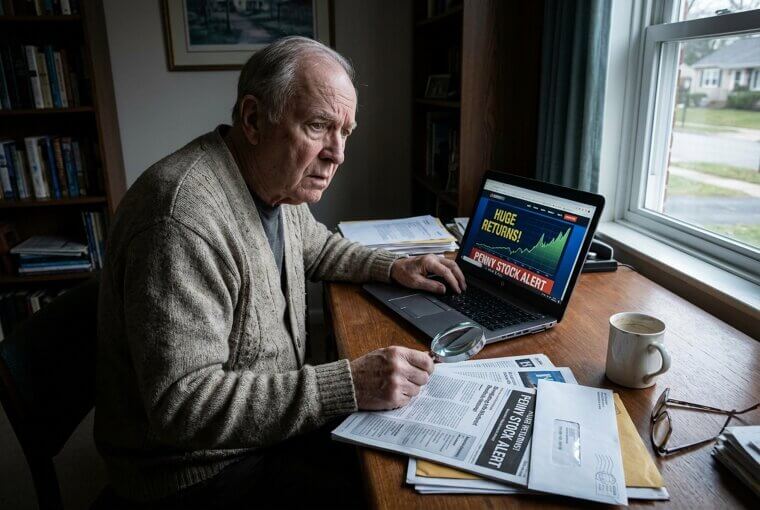
What most people don't realize is how deliberately these campaigns target adults over 60. The pitches are designed to feel like insider knowledge — a secret opportunity before the stock "takes off." But the real money flows to the promoters, not the investors. And sometimes the danger isn't a stranger online — it's someone you trust.
That "Hot Tip" From a Friend
Imagine your brother-in-law calls, genuinely excited. He's found a small company that's "about to explode." He's already invested. He's not scamming you — he believes it. And because you trust him, you put in $30,000. Three months later, the stock is worth $4,000. That's not a hypothetical nightmare. It happens constantly. Remember the recovery time concept we started with? At 60, losing $30,000 on a speculative pick could mean five or more years of tighter living — fewer trips, smaller gifts to grandkids, less breathing room for emergencies.

The social pressure is real. Nobody wants to seem timid or miss out on something a loved one is excited about. But your portfolio exists to protect your life, not someone else's enthusiasm. And speculation doesn't just come from friends — some of the most dangerous "opportunities" are marketed with a technology you've definitely heard about.
Cryptocurrency Has a Dirty Secret
You've seen the headlines. Maybe you even own some Bitcoin. Cryptocurrency is mainstream now, and there's nothing wrong with curiosity. But here's what the breathless media coverage leaves out: according to FBI data, adults over 60 lost more than $1.6 billion to crypto-related fraud in a single recent year — more than any other age group. Not younger investors. Not tech-naive beginners. People with real savings became the number one target.

And that's separate from the volatility — Bitcoin has dropped over 50% multiple times. The real danger isn't the technology itself. It's the sophisticated fraud ecosystem built around it, specifically designed to reach people with retirement savings. But volatility deserves its own closer look, because the math of big losses is worse than most people realize.
What "Volatile" Actually Costs You
Try this right now. Picture $200,000 — maybe that's your nest egg, maybe it's close. A 40% market crash drops it to $120,000. Here's where the math gets cruel: to recover, you don't need a 40% gain. You need a 67% gain just to get back to where you started. How long would that take? Historically, five to seven years in a strong market. Remember the recovery time concept from the beginning of this article? At 60 or older, those aren't just numbers — they're years you may not have.

So when someone says an investment is "volatile but worth it," translate that into real dollars lost and real years spent waiting. That mental math changes everything. And speaking of investments that feel safe but aren't — let's talk about bonds.
Long-Term Bonds Aren't Always Safe
Here's something that surprises almost everyone: bonds can crash too. In 2022, long-term U.S. Treasury bonds — the kind people buy specifically for safety — lost roughly 30% of their value. Thirty percent. On government bonds. The reason is straightforward. When interest rates rise, existing bonds with lower rates become less valuable. The longer the bond's maturity, the harder it falls. A 20-year or 30-year bond has enormous exposure to rate changes. Millions of retirees who thought they were being conservative watched their "safe" money evaporate.
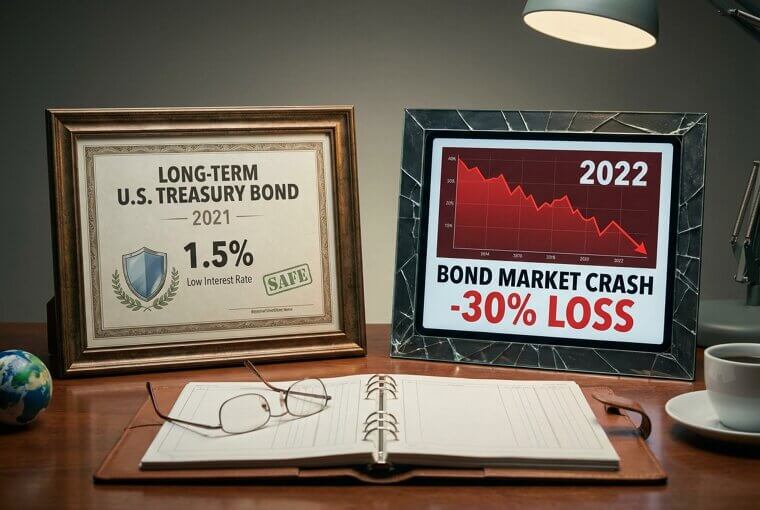
Short-term bonds — those maturing in one to three years — behave very differently. They barely flinch when rates move. The word "bond" alone tells you almost nothing about actual risk. Duration is what matters. But here's something even trickier: if you own bond funds instead of individual bonds, there's another hidden trap most people never see.
The Hidden Trap in Bond Funds
Here's what professionals know that most investors don't. When you buy an individual bond, you have a guarantee: hold it to maturity and you get your principal back. Market swings in between don't matter if you don't sell. Bond funds work completely differently. They hold hundreds of bonds, constantly buying and selling, with no maturity date. When you cash out, you get whatever the fund is worth that day — which could be significantly less than you put in.

This is why many seasoned advisors steer retirees toward individual bonds or short-duration bond funds, where price swings are minimal. Next time an advisor recommends a bond fund, ask one question: "What's the fund's average duration?" Anything above five years deserves serious scrutiny. But bonds aren't the only "safe" product with hidden costs — variable annuities might be even worse.
Variable Annuities and the Fine Print
"Guaranteed income for life." That phrase has sold billions of dollars in variable annuities to people over 60. Here's what the sales pitch leaves out: surrender charges typically lock your money away for seven to ten years. Try to withdraw early and you'll pay penalties of 7% or more. Meanwhile, annual fees of 2 to 3% quietly eat your returns every single year — whether the market goes up or down.

Remember the one-question test from earlier? If you can't access your money without a steep penalty, it fails. If you've already been pitched one of these products, that knot in your stomach is telling you something. Now let's see exactly how much those "small" fee percentages actually cost in real dollars.
How Fee Percentages Steal Thousands
Here's your homework for this afternoon. Grab any annuity paperwork you have and search for two phrases: "expense ratio" and "mortality and expense charge." These are where fees hide. Now let's do the math that should make your jaw drop. On a $300,000 annuity charging 2.5% annually, you're paying $7,500 every single year. Over a decade, that's more than $75,000 — gone. You never see a bill because the fees are deducted internally, silently shaved off your balance before you ever check it.

That $75,000 could have funded years of travel, helped a grandchild with college, or simply stayed invested and growing. The fee disclosure is right there in the prospectus — most people just never knew where to look. Now that you do, you might be wondering where else slick marketing is disguising risk as opportunity.
Real Estate Crowdfunding Sounds Great — Until It Doesn't
Those slick online ads promising 8-12% returns from real estate crowdfunding? Here's what they don't mention. Many of these investments lock your money away for five to ten years with no way out. Several platforms have collapsed entirely, leaving investors with nothing. The SEC has actually issued formal alerts warning that return projections on these platforms can be misleading or flat-out wrong. You think you're diversifying into real estate across multiple projects. In reality, you've often concentrated your money into a single development you can't exit.

Apply the liquidity test from earlier — if you can't access your money without penalty, it fails. People who needed cash for a medical emergency discovered they were trapped, watching a frozen investment lose value. But what about real estate you can actually touch — like a rental property? That comes with its own set of problems after 60.
Why Rental Properties Get Harder After 60
Owning a rental property feels like security you can drive past and touch. But after 60, the reality shifts. That midnight call about a burst pipe doesn't feel entrepreneurial anymore — it feels exhausting. A new roof runs $15,000. A tenant dispute drags on for months. And here's what financial planners see constantly: clients over 65 who are "property rich but cash poor," trapped because you can't sell a house in two weeks when a medical bill arrives.

The stakes aren't just financial. They're about your health, your stress levels, and the daily freedom you've earned. So is there a way to keep real estate in your portfolio without the headaches?
A Simpler Way to Own Real Estate
Here's your answer: REITs — Real Estate Investment Trusts. These are companies that own income-producing properties like apartments, hospitals, and shopping centers, and they trade on major stock exchanges just like regular stocks. You can buy or sell them in seconds. No tenants calling at midnight. No $15,000 roof surprises. No locked-up capital. The best part? REITs are legally required to distribute at least 90% of their taxable income as dividends, which means reliable cash flow landing in your account.

Look for diversified REITs with 10-plus year track records that hold multiple property types across different regions. You'll want to check the dividend history — consistency matters more than the highest yield. This is something you can research this evening with a simple search. Of course, not every investment wearing a familiar name is what it seems — and that's especially true with certain ETFs.
Leveraged ETFs: The Wolf in Index Clothing
You've probably heard that index funds are safe. So when you see an ETF with "S&P 500" in the name, it feels trustworthy. But leveraged ETFs — labeled 2x or 3x — are something else entirely. They use derivatives to multiply the index's daily returns. That means daily losses get multiplied too. During the 2008 financial crisis, a 3x leveraged S&P 500 ETF lost over 90% of its value. Here's the truly cruel part: even when the market recovered, many of these funds didn't.

A mathematical phenomenon called volatility decay means that daily multiplied losses compound in ways that erode value permanently — even in a recovering market. The names look almost identical to regular index funds, which is exactly why they're dangerous. If you browse investment options online, always check for "2x" or "3x" in the name. Sometimes the biggest risk isn't an investment you've never heard of — it's one you love too much to let go.
The Danger of Investing in What You Love
Picture someone who spent thirty years at a company they loved. They retired with a portfolio heavy in that company's stock — 60% of everything they'd saved. They believed in the mission, trusted the leadership, wore the logo with pride. Then one quarter, earnings disappointed. The stock dropped 40% in three months. Decades of loyalty didn't protect a single dollar. This isn't a rare story. It happens constantly with former employer stock, beloved tech giants, nostalgic American brands people grew up admiring.
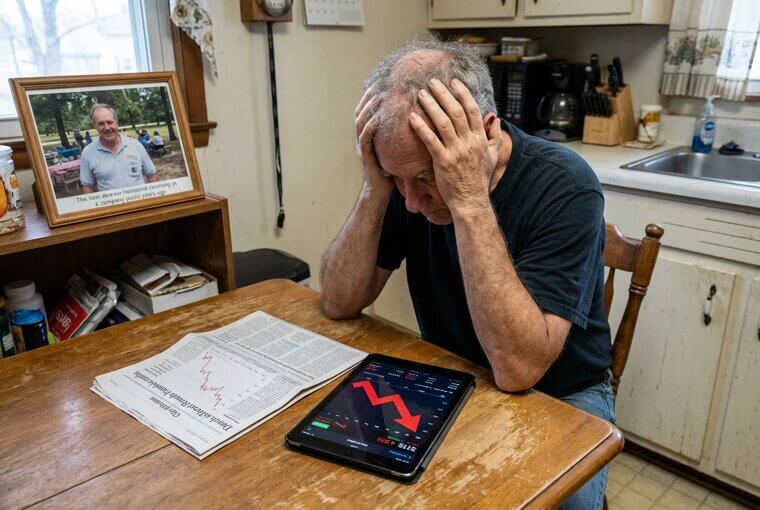
Loyalty and love are beautiful in life — in friendships, in family, in community. But your portfolio doesn't love you back. Emotional attachment creates concentration risk, and concentration risk is how a lifetime of careful saving unravels in a single bad year. So what's the rule professionals actually use to prevent this?
The 5% Rule Professionals Use
Here's the benchmark Wall Street professionals live by: no single stock should ever exceed 5% of your retirement portfolio. That means even if you absolutely love a company, it gets the same ceiling as everything else. Why so strict? Because even iconic companies collapse without warning. General Electric lost over 80% of its value between 2016 and 2018. IBM dropped nearly 50% over five years. These weren't obscure startups — they were America's most trusted names.

The 5% rule isn't about disloyalty. It's about making sure no single company has the power to reshape your retirement. Think of it as honoring what you've built by refusing to let one bad chapter erase it. Pull up your portfolio tonight and check — you might be surprised what percentage one holding quietly grew into. Speaking of things that seem protective but aren't, let's talk about gold.
Gold Isn't the Safe Haven You Think
Here's a number that shocks most people: between 2011 and 2015, gold lost nearly 45% of its value. During those four years, it paid absolutely zero income — no dividends, no interest, nothing. If you were relying on your portfolio to fund retirement, gold just sat there bleeding value while producing no cash to live on. Physical gold makes it even worse. You're paying storage fees, insurance premiums, and dealer markups that can quietly consume a significant chunk of your investment before you've earned a penny.

A small gold allocation — maybe 5% — might make sense for diversification. But those late-night TV ads and breathless infomercials pushing gold as the ultimate safe haven for retirees? They're dramatically overstating the case. Gold isn't safety. It's a shiny, expensive hope. And those ads aren't done with you — their real weapon isn't gold itself.
How Gold Ads Exploit Your Fear
Those gold ads you see aren't random — they're precision-targeted at people over 60. Notice the language: "economic collapse," "government can't be trusted," "protect your family before it's too late." Every word is engineered to trigger panic, not inform. And here's the financial gut punch: some gold dealers charge markups of 30-50% above the actual market price. That means if you buy $10,000 worth of gold, you might receive only $6,500 in actual metal value. You've lost money before the investment even begins.

Whenever an ad makes you feel like you must act now or lose everything, that's not education — that's manipulation. Fear is the most profitable sales tool in the retirement industry, and recognizing it is your strongest defense. But gold ads aren't the only "exclusive" pitch designed to flatter you into a bad decision.
Private Placements and "Exclusive" Offers
Here's what financial advisors say behind closed doors: private placements are where wealthy retirees lose the most money. These deals — startup investments, private equity funds, oil and gas partnerships — arrive wrapped in flattering language. "We're only offering this to select investors." "This isn't available to the general public." That exclusivity feels like privilege. It's actually a warning sign. These investments are illiquid, lightly regulated compared to public markets, and carry failure rates above 50% for startups.

Here's the insider distinction that matters: qualifying as an "accredited investor" means you have enough money to legally participate. It doesn't mean you should. Many advisors privately admit they'd never recommend these to anyone who can't afford to lose every dollar invested. The real expert move? Saying no without guilt. And speaking of tax-flavored temptations that sound sophisticated, oil and gas partnerships deserve their own warning.
Oil and Gas Partnerships: The Tax Trap
Here's the pitch: invest in an oil and gas partnership and write off massive tax deductions immediately. Sounds like a sophisticated move, right? The surprise is brutal. FINRA has flagged oil and gas partnerships as one of the most common sources of complaints from older investors — and some have been outright frauds. Many wells produce far less oil than projections promised, leaving investors with returns that don't come close to covering what they invested. Worse, the IRS scrutinizes these partnerships intensely, meaning that dream tax deduction can trigger an audit nightmare.

Here's the math that should stop you cold: investors regularly lose more money in failed partnerships than they ever saved in tax benefits. The sophisticated appeal is the trap itself — it makes people feel too smart to question the details. So when anyone pitches you something complicated, what's the single most powerful question you can ask them?
Three Words to Say to Any Salesperson
Here's your power move — three words that instantly change any financial conversation: "Are you a fiduciary?" A fiduciary is legally required to put your interests first. That's the highest standard in finance. Without it, the person across from you only needs to recommend something "suitable" — meaning it just has to be not completely wrong for you. Imagine the difference: a fiduciary must recommend the lowest-cost fund that fits your needs. A non-fiduciary can legally recommend a similar fund that pays them a higher commission. Same conversation, vastly different outcome for your wallet.

Try this at your very next financial meeting. Watch how people react. A true fiduciary will answer yes without hesitation. Someone who stumbles, hedges, or changes the subject just told you everything you need to know. Now that you can spot who's really on your side, let's talk about a product those non-fiduciaries love selling to people over 60.
Why Whole Life Insurance Isn't an Investment
Whole life insurance is one of the most profitable products a non-fiduciary can sell — and people over 60 are the prime target. It's pitched as an "investment vehicle" with tax-advantaged cash value growth. The reality: premiums typically run $500 to $1,000 per month, cash value grows at a glacial pace, and surrender charges can trap your money for a decade or more. Remember those invisible fees from Chapter 11? Whole life policies are loaded with them — mortality charges, administrative fees, and agent commissions that can swallow your first few years of premiums entirely.

Here's what stings most: by 60, most people's insurance needs have actually decreased. Kids are grown, mortgages are shrinking. That $800 monthly premium invested in a simple index fund could mean an extra $100,000 over a decade. The difference between comfortable and struggling in retirement sometimes comes down to a single product someone was talked into. But what happens when the pressure to invest comes from someone you'd never want to disappoint?
The Investment Your Grandkids Might Push
Your grandson's eyes light up as he tells you about a meme stock or NFT that's "going to the moon." You want to lean in, not shut him down. That instinct is beautiful — it means you value the relationship more than being right. Here's what's different, though: he's 22. If he loses everything, he has forty years of paychecks ahead. You don't. A speculative loss that's a learning experience for him could mean cancelled trips, delayed home repairs, or real stress for you.

Try this response: "I love that you're excited about investing — that's going to serve you well. My situation just needs something different right now." It honors both of you. No lectures, no eye rolls, no distance. Meanwhile, a very different kind of risk is quietly targeting retirees online — and this one looks nothing like investing.
Foreign Currency Trading Is Not Investing
Here's a number that should stop you cold: roughly 70 to 80 percent of retail forex traders lose money. That's not a typo. Foreign currency trading platforms flood the internet with ads promising easy profits from home, and they're targeting retirees specifically. The reality is closer to a casino than a portfolio. Forex uses extreme leverage — sometimes 50 to 1 — meaning a tiny market move can vaporize your entire account in hours, not months.

Even worse, many platforms marketing to American retirees are headquartered overseas, beyond the reach of U.S. regulators. If your money disappears, there's often no one to call and no agency that can help. This is one of the clearest warnings in this entire article: forex trading has no place in a retirement strategy. But let's shift gears — because the most important "investment" after 60 might not feel like one at all.
Your Emergency Fund Is an Investment Too
Here's something you can do right now that might matter more than any stock pick: open a high-yield savings account. After 60, you need 12 to 18 months of living expenses in accessible cash — not the 3 to 6 months younger people keep. Why more? Because replacing lost income at this stage takes longer. Right now, many online banks are paying 4 to 5 percent on savings. That's real money on a meaningful cushion.

Your steps are simple: search "high-yield savings account," compare rates on Bankrate or NerdWallet, and open one this week. Remember the liquidity test from earlier? This is liquidity perfected — your money available tomorrow, earning returns today, with zero risk of loss. Now imagine applying that same clarity to your entire portfolio at once.
The Portfolio Checkup Most People Skip
This weekend, set aside twenty minutes for something most people never do. Pull up every account — brokerage, 401(k), IRA, annuity — and run three simple tests from this article. First, does any single holding represent more than 5% of your total portfolio? Second, can you access every investment within 12 months without penalty? Third, are your total fees below 1% annually? Write your answers down. Be honest.

If you answered "no" to even one question, you've just identified exactly where your portfolio needs attention. No guessing, no panic — just clarity. You might be surprised how empowering a single page of honest answers feels. And if you're wondering what the smartest, happiest retirees actually hold in their portfolios, the answer is simpler than you'd expect.
What the Happiest Retirees Actually Own
Financial researcher Wes Moss studied hundreds of retirees for his book "You Can Retire Sooner Than You Think" and found something professionals already knew: the happiest retirees don't have the cleverest portfolios. They have the simplest ones. Low-cost index funds, a reasonable bond allocation, and enough cash to sleep soundly. That's essentially it. No exotic alternatives, no complex strategies, no chasing the next big thing.

The expert insight here is counterintuitive: boring is sophisticated. Professionals who manage money for a living generally keep their own retirement portfolios remarkably plain. They know that predictability and low fees compound into something flashy investments rarely deliver — genuine peace of mind. And that peace? It's not just about money.
It's Not About Fear — It's About Freedom
Think about what you actually worked all those years for. It wasn't a number on a screen. It was the freedom to say yes — yes to helping a grandchild with college, yes to that trip you've been postponing, yes to handling a health surprise without panic. Every risky investment we've discussed in this article threatens that freedom. Not theoretically. Specifically. A $50,000 loss at 35 is a setback. At 65, it's two years of memories you don't get to make.

We've returned to recovery time throughout this journey because it's the truth that holds everything together. Protecting your money was never about fear — it was about protecting your time with the people you love. That's the only asset you can never earn back. So what's the single smartest move you can make right now?
One Smart Move You Can Make Today
Here's your one move: visit NAPFA.org or the Garrett Planning Network website and find a fee-only fiduciary financial advisor near you. Fee-only means they don't earn commissions selling you products. Fiduciary means they're legally required to put your interests first. Many offer a free or low-cost initial consultation — thirty minutes is all you need. Walk in with one question: "Looking at my portfolio, what would you remove?" That single question unlocks more clarity than hours of research.

You've read thirty sections. You understand recovery time, liquidity, fees, and the tactics used to separate retirees from their money. Now hand that knowledge to a professional who can sharpen it. Asking for a second opinion isn't weakness — it's the smartest investment you'll ever make.Disclaimer: This story is based on real events. However, some names, identifying details, timelines, and circumstances have been adjusted to protect the privacy of the individuals involved. The images in this article were created with AI and are illustrative only. They may include altered or fictionalized visual details for privacy and storytelling purposes